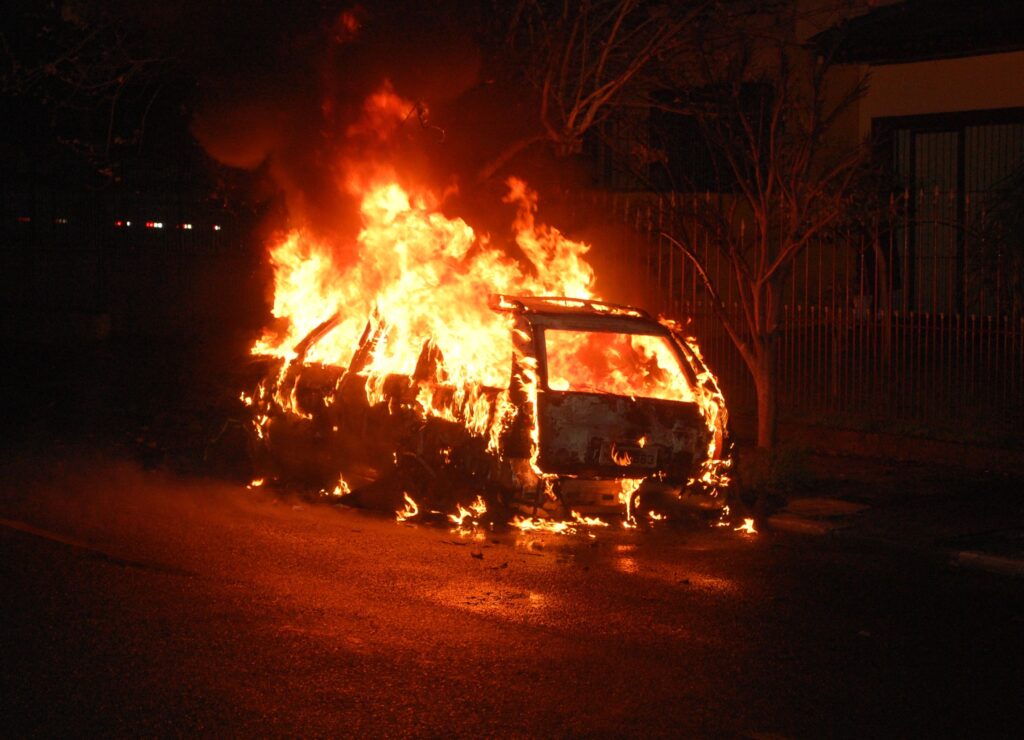
You park your car outside your Florida home, turn off the engine, and walk inside.
Twenty minutes later, someone notices smoke coming from beneath the hood.
By the time firefighters arrive, the engine compartment has suffered serious damage.
Nobody crashed into your vehicle. Nobody stole it. There was no hurricane or flood.
But the repair estimate could still be thousands of dollars—or the car could be a total loss.
Will your car insurance pay for the fire?
For many Florida drivers, the answer depends on one coverage they may not realize they need: comprehensive insurance.
The Florida Department of Financial Services identifies fire as a type of loss generally covered under comprehensive, also called Other Than Collision, coverage.
However, not every situation involving a burning or overheated vehicle is handled the same way.
An accidental electrical fire, a mechanical breakdown that produces heat, an intentionally set fire, and fire damage following a collision can involve different coverage questions.
The distinction matters because insurance may cover resulting fire damage without covering the failed mechanical component that started the problem.
This guide explains how Florida car insurance handles vehicle fires, what to do immediately after a fire, how deductibles work, when a vehicle may be totaled, and which questions to ask before accepting a claim decision.
Does Comprehensive Insurance Cover a Car Fire in Florida?
Generally, yes.
Comprehensive coverage protects an insured vehicle against certain losses that do not result from a collision.
According to the Florida Department of Financial Services, common examples include fire, theft, windstorm, vandalism, flood, falling objects, and animal-related damage.
If your vehicle is damaged by an accidental fire and you had comprehensive coverage when the loss occurred, the damage may qualify for a comprehensive claim.
The insurer will still review the circumstances, policy terms, deductible, and any applicable exclusions.
For example, suppose a parked vehicle experiences an accidental electrical fire that damages its wiring, engine compartment, and hood.
The resulting physical damage may fall within comprehensive coverage.
But if a worn electrical component simply stops functioning without a covered fire or other insured event, that repair may be treated as mechanical or electrical breakdown rather than an insured loss.
The difference is not always obvious from the driver’s perspective.
That is why identifying and documenting the cause of the damage can be important.
What If Your Car Catches Fire While You Are Driving?
A fire that begins while the vehicle is moving may still qualify for comprehensive coverage.
The fact that the engine was running does not automatically turn a fire into a collision claim.
What matters is the cause of the loss and the applicable policy language.
Consider a driver traveling through Jacksonville when smoke begins coming from the engine compartment.
The driver pulls over safely, exits the vehicle, and calls emergency services.
If the vehicle suffers accidental fire damage without a collision, comprehensive coverage may apply.
Now consider a different situation.
A driver crashes into a roadside barrier, and the collision causes a fire.
The insurer may analyze the loss under collision coverage because the fire followed the impact.
If multiple causes are involved, the insurer may need to determine how the policy responds.
Do not assume the same deductible or coverage category applies to every vehicle fire.
Ask the adjuster which coverage is being used and why.
Comprehensive vs. Collision vs. Mechanical Breakdown
The following comparison shows why the cause of the damage matters.
| Situation | Coverage That May Apply | Important Limitation |
|---|---|---|
| Accidental fire in a parked vehicle | Comprehensive | Subject to policy terms and deductible |
| Electrical fire while driving, without a crash | Comprehensive | Cause and coverage must be evaluated |
| Fire caused by a covered collision | Collision | Depends on how the policy classifies the loss |
| Vehicle fire caused by vandalism or arson by another person | Comprehensive | Investigation and policy exclusions may apply |
| Engine fails without catching fire | Usually not standard comprehensive or collision | Mechanical breakdown is generally excluded |
| Electrical component stops working without a covered event | Usually not standard auto physical-damage coverage | Warranty or other protection may apply |
| Fire damages another person’s property | Potentially applicable liability coverage | Legal responsibility and exclusions matter |
| Vehicle fire following a flood | Comprehensive may apply | Insurer must evaluate the facts and damage |
This table is a general explanation, not a guarantee of payment.
Your insurer must apply the actual policy to the documented facts.
Does Florida’s Minimum Car Insurance Cover Fire Damage?
Generally, no.
Florida’s basic required auto insurance includes Personal Injury Protection and Property Damage Liability coverage for most vehicles subject to the state’s standard requirements.
These coverages have different purposes.
Personal Injury Protection (PIP) addresses qualifying injury-related expenses arising from covered motor vehicle accidents.
Property Damage Liability (PDL) generally addresses covered damage you are legally responsible for causing to someone else’s property.
Neither is designed to repair your own vehicle after an accidental fire.
For damage to your own vehicle from a qualifying fire, comprehensive coverage is usually the relevant protection.
This distinction is especially important for drivers who carry liability-only policies to reduce their premiums.
You can have an active Florida insurance policy and still have no insurance payment available for a fire that destroys your own car.
If you are uncertain about your coverage, check your declarations page for a line labeled Comprehensive or Other Than Collision.
Also check the deductible.
Electrical Fires: What Insurance May Cover
Modern vehicles contain extensive electrical systems.
Wiring, batteries, connectors, control modules, and other components operate throughout the vehicle.
An electrical problem may sometimes contribute to a fire.
However, an insurer may distinguish between the defective component and the damage resulting from the fire.
Imagine that an electrical component fails and ignites surrounding material.
The component itself may have failed because of wear, a defect, or another excluded cause.
But the resulting accidental fire damages additional covered vehicle components.
Depending on the policy and the facts, the resulting fire damage may be covered even when the original failed part is not.
That distinction is important.
A repair estimate should identify both the suspected source of the fire and the components damaged by the fire.
Ask your adjuster:
“Is the claim being denied because of the original failed component, or are you also denying the resulting fire damage?”
The answer may help clarify whether the insurer has evaluated the entire loss.
Engine Fires: Is the Damage Covered?
An engine fire is not necessarily the same thing as engine failure.
Suppose an engine develops an internal mechanical problem and stops working.
If there is no covered accident or fire, ordinary mechanical failure generally is not covered by standard comprehensive or collision insurance.
Now suppose an accidental fire develops in the engine compartment and damages multiple vehicle systems.
The resulting fire damage may qualify for comprehensive coverage.
The insurer may investigate whether there was an actual fire, what started it, and what damage resulted.
A mechanic’s explanation, photographs, and fire department records may help establish the facts.
Avoid assuming that every engine-related problem is covered simply because smoke was visible.
Smoke may come from overheating, leaking fluids, or another malfunction without a covered fire.
A qualified inspection is often necessary.
What About a Car Fire Caused by a Defective Part?
This situation can involve more than one potential source of recovery.
A vehicle or component defect may raise questions about:
- Comprehensive insurance for qualifying resulting fire damage.
- A manufacturer’s warranty.
- A recall or manufacturer remedy.
- A possible product-liability claim, depending on the facts.
These options are not interchangeable.
A warranty may address a defective component under its terms.
Comprehensive insurance may address resulting covered fire damage.
A manufacturer or other party may potentially bear responsibility if a legally actionable defect caused the loss.
Do not assume that an active recall automatically means the manufacturer must pay for every related expense.
Similarly, do not assume an insurance claim must wait until a manufacturer completes an investigation.
Contact your insurer promptly, preserve available evidence, and ask whether a manufacturer or warranty administrator should also be notified.
Before allowing the damaged vehicle or suspected component to be discarded, ask whether it needs to be preserved for inspection.
Seven Steps to Take After Your Car Catches Fire
1. Put safety first
If you notice flames or smoke, stop in a safe location if you can do so.
Turn off the vehicle if safe, leave it, and move away from traffic and the burning vehicle.
Call 911 when emergency assistance is needed.
Do not attempt to open a hot engine compartment or approach a burning vehicle to retrieve belongings.
Do not reenter the vehicle.
Your safety and the safety of passengers and bystanders matter more than the car.
2. Do not drive the vehicle afterward
Even if the visible fire appears minor, heat may have damaged wiring, fuel lines, structural components, or safety systems.
A vehicle that starts after a fire is not necessarily safe to drive.
Arrange for a qualified professional to assess it.
If necessary, have it towed.
3. Document the damage safely
Once emergency personnel have cleared the scene and it is safe, take photographs from appropriate locations.
Photograph the exterior, affected areas, and any visible damage.
Record the date, time, location, and what you observed before the fire.
Do not disturb damaged components merely to obtain photographs.
4. Obtain the incident information
If firefighters or law enforcement responded, request the relevant incident or report number.
Ask how to obtain a copy of the report when it becomes available.
An official report may provide useful information about the incident, although the insurer may still conduct its own investigation.
5. Contact your insurer promptly
Report the fire and explain where the vehicle is located.
Ask whether comprehensive or collision coverage may apply.
Confirm your deductible and whether the insurer wants to inspect the vehicle before it is moved or repaired.
6. Preserve records and possible evidence
Keep photographs, towing invoices, repair records, maintenance records, and relevant communications.
If you recently had electrical or mechanical work performed, retain those invoices too.
Do not authorize disposal of the vehicle or suspected failed parts without first checking whether the insurer or another investigating party needs them.
7. Ask for a written claim explanation
If the insurer approves the claim, review the estimate or settlement.
If it denies part or all of the claim, request a written explanation identifying the policy provisions and factual basis for the decision.
That makes it easier to understand the decision and identify any missing documentation.
How Much Will Insurance Pay for a Car Fire?
The payment depends on the covered damage, policy terms, deductible, and whether the vehicle can reasonably be repaired.
Consider three hypothetical examples.
| Covered Fire Damage | Comprehensive Deductible | Illustrative Insurer Payment |
|---|---|---|
| $2,500 | $500 | $2,000 |
| $7,000 | $1,000 | $6,000 |
| $12,000 | $500 | $11,500 |
These calculations assume that the entire listed amount is covered, the loss is repairable, and no other limits or adjustments apply.
They are not actual Florida repair estimates.
A real claim can involve additional questions about replacement parts, labor, prior damage, vehicle value, and whether repair is economically appropriate.
If the car is declared a total loss, the calculation changes.
What If the Fire Totals Your Car?
A vehicle may be considered a total loss when the damage is sufficiently severe under the applicable policy, insurer procedures, and Florida law.
Fire damage can be especially complicated because heat and smoke may affect components beyond the visibly burned area.
Electrical wiring, electronic modules, interior materials, and structural components may require evaluation.
If the vehicle is totaled, the settlement is generally based on the applicable valuation provisions of the policy, often involving the vehicle’s actual cash value before the loss, subject to deductible and other adjustments.
The settlement is not automatically equal to:
- The price you originally paid.
- The amount remaining on your auto loan.
- The price of a brand-new replacement.
- The amount you believe the vehicle should be worth.
Ask for the valuation report and review the vehicle’s year, trim, mileage, equipment, condition, and comparable vehicles used.
If information is incorrect, provide documentation and request a review.
A recent article on GuardedLifeInsurance.com explains how insurers value totaled vehicles in Florida and what drivers should check before accepting a settlement.
What If You Still Owe Money on the Car?
A fire can create a serious financial problem when the vehicle is financed.
Suppose the insurer determines that the vehicle’s covered total-loss value is $17,000.
After a $500 deductible, the illustrative payment is $16,500.
But the driver still owes $20,000 on the loan.
That leaves a potential $3,500 difference, before considering any other applicable adjustments or benefits.
Comprehensive coverage generally does not promise to pay off the entire loan.
Guaranteed Asset Protection, commonly called GAP coverage, may help with certain eligible differences between a covered total-loss settlement and the loan or lease balance.
However, GAP contracts have their own conditions, exclusions, and limits.
Some may not cover every deductible or amount added to a loan.
Ask the lender for a current payoff statement and check whether you purchased GAP protection.
Do not assume the loan disappears because the car was destroyed.
Does Insurance Cover a Fire Caused by Another Vehicle?
Possibly.
Imagine your car is parked next to another vehicle that catches fire.
Flames spread and damage your car.
Your comprehensive coverage may respond to the qualifying fire damage, subject to the policy and deductible.
There may also be a potential claim against another party if that party is legally responsible.
But the fact that the fire began in someone else’s vehicle does not automatically prove negligence.
The cause must be investigated.
If your own insurer pays a covered claim, it may pursue recovery from a responsible party when appropriate.
Ask whether deductible recovery is possible if another party is ultimately found liable.
Does Insurance Cover a Car Fire in Your Garage?
Comprehensive coverage may apply to qualifying fire damage to the insured vehicle even when it is parked in a residential garage.
However, damage to the garage itself is a separate coverage question.
Depending on ownership, responsibility, and the cause of the fire, homeowners insurance or another property policy may be relevant to building damage.
Do not assume your auto comprehensive coverage repairs the garage.
Likewise, do not assume a homeowners policy automatically replaces your burned vehicle.
Notify the relevant insurers and ask how the claims should be coordinated.
Keep separate records of vehicle damage, building damage, and damaged personal property.
What If Someone Intentionally Sets Your Car on Fire?
Arson or vandalism by another person may qualify as a comprehensive loss.
The insurer will generally investigate the circumstances and apply the policy’s terms and exclusions.
Intentional damage caused by an insured person can raise very different issues, including exclusions and potential insurance fraud concerns.
If you suspect that someone deliberately set the fire, report the situation to law enforcement.
Avoid accusing a specific person without evidence.
Preserve any relevant surveillance footage, photographs, or witness information.
Will Insurance Pay for a Rental Car After a Fire?
It may, if you purchased applicable rental reimbursement coverage and the loss meets the policy’s conditions.
Rental reimbursement is usually an optional benefit.
It is not automatically included just because you have comprehensive coverage.
The Florida Department of Financial Services explains that rental reimbursement can provide replacement transportation up to specified policy limits when a vehicle is inoperable or unsafe following a covered loss.
Ask the insurer about:
- The daily reimbursement limit.
- The maximum total benefit.
- Any waiting period.
- When rental eligibility begins and ends.
- Whether the insurer has a preferred rental provider.
Do not rent an expensive vehicle assuming the insurer will reimburse the entire bill.
Will Insurance Cover Towing After a Vehicle Fire?
Potentially.
A vehicle damaged by fire may need towing to a secure location, repair facility, or inspection site.
Reasonable towing costs associated with a covered loss may be considered under the claim, depending on the policy.
A separate towing and labor benefit may also be relevant.
Ask where the vehicle should be transported and whether the insurer will arrange the tow.
If it is taken to a storage yard, ask about daily charges immediately.
Storage expenses can accumulate while a fire claim is investigated.
Do not assume every day of storage will be reimbursed.
Five Mistakes That Can Complicate a Car Fire Claim
Mistake 1: Assuming basic Florida insurance covers the fire
PIP and Property Damage Liability generally do not replace your own burned vehicle.
Check for comprehensive coverage.
Mistake 2: Throwing away damaged components
The insurer or another party may need to inspect the suspected source of the fire.
Preserve evidence when safe and practical.
Mistake 3: Describing an unknown cause as a confirmed fact
If you do not know what started the fire, say so.
Explain what you observed rather than guessing.
Mistake 4: Accepting an incomplete damage assessment
A fire can damage systems that are not immediately visible.
Ask whether the estimate includes necessary inspection and diagnostics.
Mistake 5: Ignoring the deductible and vehicle value
Before making financial decisions, understand how much the insurer may pay and whether the vehicle will be repaired or totaled.
Questions to Ask Your Insurance Adjuster
Before the claim progresses, ask:
- Which coverage applies to this fire?
- What deductible will I pay?
- Is the insurer investigating the cause?
- Do I need to preserve any components or records?
- Will you inspect the vehicle before repairs begin?
- Is the damage being evaluated for repair or total loss?
- Are towing and storage charges eligible for payment?
- Do I have rental reimbursement?
- How will the vehicle’s value be calculated if it is totaled?
- What can I do if I disagree with the claim decision?
Write down the answers and save any written correspondence.
Frequently Asked Questions
Does comprehensive insurance cover an electrical fire in Florida?
Generally, accidental fire damage may be covered under comprehensive insurance. However, the insurer may distinguish the resulting fire damage from an excluded electrical or mechanical failure that caused the incident.
Does car insurance cover an engine fire?
It may, if the engine compartment suffers damage from a qualifying covered fire. Ordinary engine failure without a covered event is generally not covered by standard auto physical-damage insurance.
Does liability-only insurance cover a car fire?
Generally not when the fire damages your own vehicle. Comprehensive coverage is typically the relevant protection for qualifying accidental fire damage.
Does car insurance cover a parked car that catches fire?
Comprehensive coverage may apply even if the vehicle was parked and the engine was off. Coverage depends on the policy and the cause of the loss.
Will insurance cover a car fire caused by a bad battery?
The insurer may consider resulting accidental fire damage under comprehensive coverage, but the failed battery itself may be excluded as mechanical or electrical breakdown. The facts and policy language matter.
Does insurance cover a car fire caused by a manufacturer defect?
Comprehensive insurance may cover qualifying resulting fire damage. A manufacturer warranty, recall remedy, or potential claim against a responsible party may also be relevant.
Will insurance pay the full value of a burned car?
If the vehicle is totaled, payment generally follows the policy’s valuation provisions, often based on actual cash value, subject to deductible and other adjustments. It does not automatically equal the original purchase price or loan balance.
Does comprehensive insurance cover arson?
A fire intentionally set by an unrelated third party may be covered under comprehensive insurance, subject to investigation and policy terms. Intentional acts by an insured person raise different exclusions and legal concerns.
Do I need a fire department report to file a claim?
Not every claim necessarily requires the same documents, but an available fire department report can be useful evidence. Ask your insurer what it needs and provide the incident number when available.
Can I file a claim if the cause of the fire is unknown?
Yes, you can report the loss even when the cause is unknown. The insurer will evaluate the facts and coverage. Do not invent or speculate about a cause.
The Bottom Line
A vehicle fire can happen without a crash, theft, or severe weather.
For Florida drivers, comprehensive coverage is generally the insurance protection that responds to qualifying accidental fire damage.
But there is an important difference between damage caused by a fire and a mechanical or electrical component that simply failed.
That difference can affect what the insurer pays.
If your vehicle catches fire, prioritize safety, document the incident, report the claim promptly, and preserve relevant evidence.
Then confirm which coverage applies, the deductible, and whether the vehicle will be repaired or declared a total loss.
If your vehicle has not experienced a fire, now is a good time to review your declarations page.
Understanding your coverage before an emergency is much easier than discovering a costly gap afterward.
Compare Florida Car Insurance Coverage
When shopping for Florida auto insurance, don’t compare premiums alone.
Review comprehensive coverage, collision coverage, deductibles, rental reimbursement, towing benefits, and policy exclusions.
A comparison service such as EverQuote may help you explore available insurance options from participating providers.
Always confirm the actual policy terms, coverage limits, and insurer information before purchasing.
Official Sources
Florida Department of Financial Services — Personal Automobile Insurance Overview:
https://myfloridacfo.com/division/consumers/understanding-insurance/personal-automobile-insurance-overview
Florida Office of Insurance Regulation — Automobile Insurance:
https://floir.gov/property-casualty/automobile-insurance
Florida Department of Financial Services — Automobile Insurance Consumer Resources:
https://www.myfloridacfo.com/division/ica/fullcoverage/auto
Florida Statutes §324.022 — Financial Responsibility for Property Damage:
https://www.flsenate.gov/Laws/Statutes/2025/0324.022
Affiliate Disclosure
Guarded Life Insurance may receive compensation from certain third-party services or links when an applicable affiliate arrangement is active. Any such relationship will be disclosed where relevant. Readers should independently evaluate insurance providers, policy terms, deductibles, and coverage.
Insurance and Legal Disclaimer
This article is provided for general educational purposes and does not constitute individualized insurance, legal, or financial advice. Guarded Life Insurance is not an insurance company or licensed insurance agent. Coverage, deductibles, exclusions, valuations, and claim decisions depend on the actual insurance policy, the circumstances of the loss, and applicable law. Contact your insurer, a licensed insurance professional, or a qualified attorney for advice about your specific situation.